
Cash flow is the lifeblood of any wholesale business, and it is also one of the hardest things to keep steady. Enterprise Resource Planning (ERP) systems give wholesalers a practical way to tackle these problems. Wholesale businesses commonly struggle with slow-paying customers, high inventory costs, and unpredictable swings in demand.
An ERP system brings inventory, sales, purchasing, and customer payments into one platform and shows them in real time. This report looks at the main cash flow challenges wholesalers face, the benefits of ERP adoption, and strategies to put into practice.
Key Cash Flow Challenges in Wholesale
1. Slow-Paying Customers
Wholesalers often extend long payment terms (Net 45, Net 60, or more) to retain large accounts. The result is a gap between paying suppliers and collecting from buyers, which strains working capital.
Bad debt refers to outstanding amounts a company considers uncollectible. To reduce the risk:
- Run credit checks on new customers before extending terms.
- Reserve credit for customers with a strong payment history.
- Require deposits from new or unproven customers.
- Offer early-payment discounts (for example, 2/10 net 30) to speed up collections.
- Monitor accounts receivable aging so overdue invoices are chased before they become write-offs.
2. High Inventory Costs
Wholesalers must keep enough stock to meet demand, but inventory is cash that has been converted into goods not yet sold. The longer stock sits, the more it costs in storage, insurance, handling, shrinkage, and obsolescence. Overstocking ties up capital, while understocking means lost sales and unhappy customers.
3. Demand Fluctuations
Seasonality, market trends, and supply chain disruptions make demand hard to predict. Without accurate data, wholesalers either over-order and tie up cash, or under-order and miss revenue.
4. Inefficient Cash Flow Management
Poor cash flow management can cause financial strain, slow growth, and erode profitability. Wholesalers need to manage it proactively by:
- Tracking and forecasting cash movements rigorously
- Negotiating favorable payment terms with suppliers
- Using efficient inventory management systems
- Exploring financing options before a shortfall occurs
Done well, this protects profitability and strengthens relationships with both customers and suppliers.
How an ERP System Improves Cash Flow
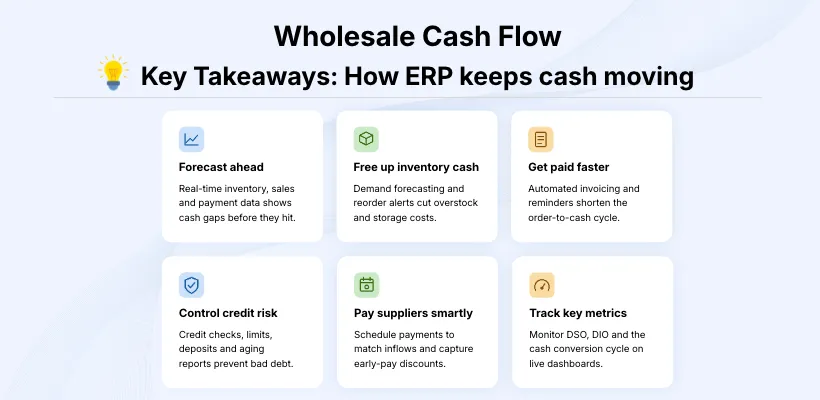
An ERP gives wholesalers real-time visibility into inventory, sales, and payments. Key benefits include:
- Improved cash flow forecasting: Live data on stock levels, open orders, receivables, and payables lets businesses anticipate shortfalls and act early.
- Efficient inventory management: Demand-based reorder points, safety stock levels, and ABC analysis help optimize stock and reduce the cost of overstocking.
- Automated invoicing and payment processing: Invoices are generated and sent immediately, payment reminders run automatically, and reconciliation is faster, which shortens the collection cycle and cuts administrative effort.
- Credit control and customer risk management: Credit limits can be set per customer, and orders can be flagged or held automatically when an account exceeds its limit or has overdue invoices.
- Better supplier and payables management: Tracking due dates lets you take early-payment discounts where they make sense and otherwise pay as late as terms allow, preserving cash without harming relationships.
- Financial reporting and KPIs: Dashboards track metrics such as Days Sales Outstanding (DSO), Days Inventory Outstanding (DIO), Days Payable Outstanding (DPO), and the overall cash conversion cycle.
- Multi-currency and multi-location support: For wholesalers trading across borders or warehouses, consolidated reporting avoids blind spots and reduces currency-related surprises.
Practical Strategies to Enhance Cash Flow
| Strategy | Action | ERP Support |
|---|---|---|
| Shorten the collection cycle | Offer early-payment discounts, send automated reminders | Automated invoicing, AR aging reports |
| Reduce excess stock | Set reorder points, identify slow-moving items, run clearance promotions | Inventory analytics, demand forecasting |
| Control credit risk | Set credit limits, require deposits from new customers | Credit limit alerts, order holds |
| Optimize payables | Negotiate longer terms, schedule payments strategically | Payables scheduling, due-date tracking |
| Plan ahead | Build rolling 13-week cash flow forecasts | Real-time financial dashboards |
Getting Started with ERP Implementation
- Assess your pain points: Identify where cash is stuck (receivables, inventory, or payables).
- Define KPIs: Set baseline figures for DSO, DIO, and DPO so you can measure improvement.
- Choose a scalable solution: Look for modules covering financials, inventory, sales, and purchasing, with strong reporting.
- Clean your data: Accurate customer, item, and pricing data is essential for reliable forecasts.
- Train your team: Adoption is what delivers results, so invest in onboarding.
Stay Ahead with Globe3 ERP Software
Globe3 ERP helps wholesalers manage the full cash cycle in one system. With an account established, you can also generate positive cash flow through on-demand invoice financing: submit an invoice for funding and get paid the same day.
Learn more about Globe3 ERP and how it can strengthen your wholesale business’s cash flow today.